


How can the heating and cooling efficiency of commercial water dispensers be optimized for different flow requirements in various locations?
Release Time : 2026-02-17
Commercial water dispensers have significantly different flow rate requirements in various locations, from office buildings and schools to factory workshops, with varying user water consumption frequencies, single-use volumes, and temperature demands. If heating or cooling efficiency cannot match the actual flow rate, it can easily lead to unstable water temperatures, excessively long waiting times, or wasted energy. Therefore, optimizing heating and cooling efficiency requires collaborative improvements across multiple dimensions, including hardware configuration, intelligent control, structural design, and maintenance management, to adapt to the dynamic needs of different scenarios.
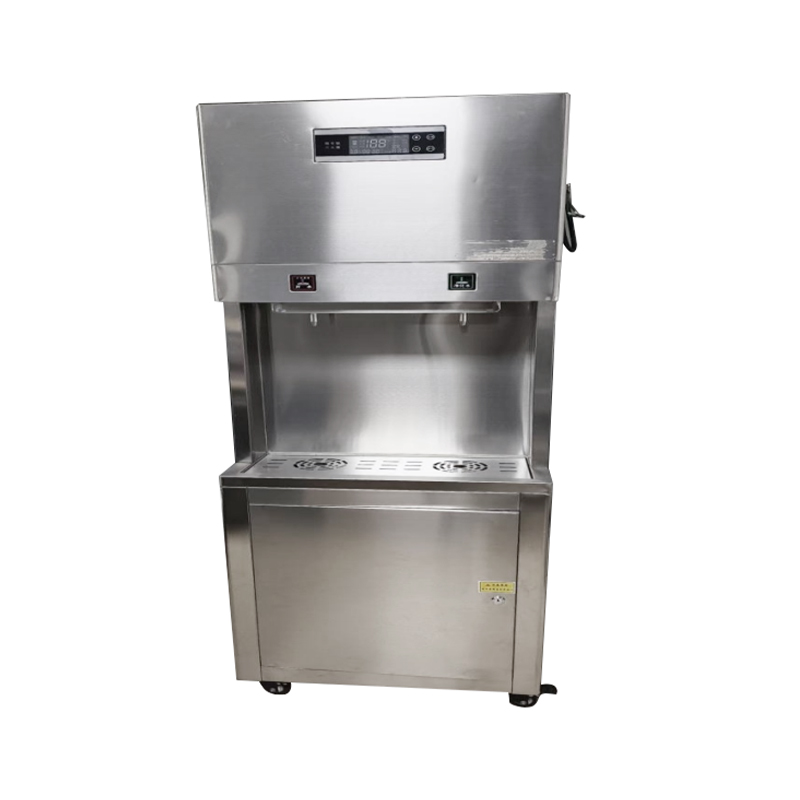
Optimizing heating efficiency needs to focus on power matching and heat utilization. In densely populated areas, such as large factories or school canteens, during peak hours or breaks when water is drawn in large quantities and frequently, traditional low-power heating elements are prone to insufficient heat supply, leading to a drop in water temperature. In such cases, high-power heating elements, such as heating elements of 6 kilowatts or higher, are required to increase heat exchange efficiency by increasing the heating area. For example, compared to a straight design, an elliptical heating element can increase the contact area with water, resulting in more even heat distribution and shorter heating time. Meanwhile, the step-heating technology, through its layered boiling design, heats only the amount of water needed at the moment, avoiding repeated heating of the entire tank, thus improving efficiency and reducing energy consumption.
Improved cooling efficiency relies on the synergy between the cooling system and heat dissipation design. In high-temperature environments or during summer, the demand for cold water from commercial water dispensers surges. If the cooling capacity is insufficient, the water temperature can easily rise again. The compressor cooling system needs to be equipped with a high-efficiency compressor, such as a variable-frequency screw compressor, which can adjust its speed according to the real-time load, avoiding efficiency losses under partial load. Furthermore, optimizing the heat dissipation system is crucial. By increasing the heat sink area, using variable-frequency fans, or adding air duct designs, heat dissipation can be accelerated, preventing the condenser from experiencing a decrease in cooling efficiency due to poor heat dissipation. For small spaces, although electronic cooling (semiconductor cooling chips) has weaker cooling capacity, basic needs can still be met by optimizing the heat dissipation structure, such as increasing the number of heat sinks at the hot end.
The introduction of an intelligent control system enables dynamic efficiency adjustment. By installing flow sensors and temperature probes, the water dispenser can monitor water dispensing frequency, water volume, and water temperature changes in real time. For example, during peak hours, the system automatically increases heating or cooling power to ensure stable water temperature; during off-peak hours, it reduces power to save energy. Some high-end models also support a scheduling function, allowing users to pre-set heating or cooling times to avoid prolonged idling. Furthermore, the intelligent control system can connect with an IoT platform to predict peak water usage through data analysis and adjust operating status in advance, further improving efficiency.
The rational design of the water tank's capacity and structure directly affects water supply and efficiency. In locations with high flow demands, large-capacity water tanks can reduce heating or cooling frequency, but attention must be paid to the tank material and insulation performance. Using a stainless steel inner tank and polyurethane foam layer can reduce heat loss and extend the water temperature retention time. Simultaneously, the internal flow channel design of the water tank should avoid dead corners to prevent scale buildup from affecting heat exchange efficiency. For step-heating models, the water tank needs to be divided into multiple heating layers to ensure that only one layer of water is heated at a time, avoiding heat waste.
Regular maintenance and cleaning are key to ensuring long-term efficiency. Scale buildup on heating elements significantly reduces heat conduction efficiency, leading to longer heating times; dust accumulation in the cooling system affects heat dissipation, reducing cooling capacity. Therefore, a regular maintenance plan is necessary, including cleaning the water tank, descaling the heating element, checking refrigerant pressure, and cleaning the heat sink. Furthermore, timely replacement of the filter cartridge prevents impurities from entering the heating or cooling system, avoiding equipment malfunctions.
The application of energy-saving technologies can further reduce overall costs. Heat exchange heating technology recovers waste heat from boiling water to preheat cold water, improving heating efficiency and reducing energy consumption; variable frequency technology dynamically adjusts the compressor or pump speed according to the load, avoiding energy waste. In terms of cooling, using environmentally friendly refrigerants not only meets environmental requirements but also improves system energy efficiency.
Scenario-based customization is the ultimate direction for optimizing efficiency. Different locations have significantly different flow requirements, necessitating the selection of suitable models based on specific scenarios. For example, high-power, large-capacity models can be used in factory workshops to meet the demand for large amounts of water in a short time; while small-to-medium power, intelligent temperature-controlled models are suitable for offices, balancing efficiency and energy saving. Through scenario-based customization, commercial water dispensers can achieve a balance between efficiency and cost, providing users with better service.