


How to solve the problem of filter media clogging during the operation of sewage treatment equipment?
Release Time : 2025-12-24
Filter media clogging is a common problem affecting treatment efficiency and effluent quality during the operation of sewage treatment equipment. Its causes involve multiple aspects, including influent water quality, filter media characteristics, equipment design, and operation management. To address this issue, a comprehensive approach is needed, encompassing source control, process optimization, sewage treatment equipment maintenance, and emergency response, to restore filter media permeability and ensure stable system operation.
Influent water quality is one of the core factors affecting filter media clogging. If the content of suspended solids, colloids, grease, or organic matter in the wastewater is too high, these impurities easily form a dense clogging layer on the filter bed surface. For example, grease in catering wastewater easily adheres to the filter media surface, forming a low-permeability hard shell; fine fibers or particulate matter in industrial wastewater may penetrate deep into the filter media pores, causing deep clogging. To address this, enhanced interception is needed during the pretreatment stage, such as by adding screens, equalization tanks, or sedimentation tanks to reduce influent turbidity. For oily pollutants, oil separators or flotation devices can be used for separation. For high-concentration organic wastewater, hydrolysis acidification or coagulation sedimentation processes can reduce colloidal substances, thus reducing the load on the filter media at the source.
The characteristics of the filter media itself directly affect its anti-clogging ability. Uneven particle size distribution, low porosity, or insufficient specific surface area can easily lead to short-circuiting of water flow or a decrease in interception capacity. For example, if the particle size of quartz sand filter media is too small, it may quickly clump due to excessive surface adsorption; if the particle size is too large, the porosity is insufficient, making it easily clogged by impurities. In such cases, appropriate filter media should be selected based on the water quality characteristics: for high-turbidity wastewater, anthracite or ceramsite with larger particle size and higher porosity can be used; for slightly polluted water sources, activated carbon or fiber ball filter media with a large specific surface area can be used. In addition, regularly monitoring the particle size distribution and mud content of the filter media, and promptly replenishing or replacing aging filter media, is crucial for maintaining filter bed permeability.
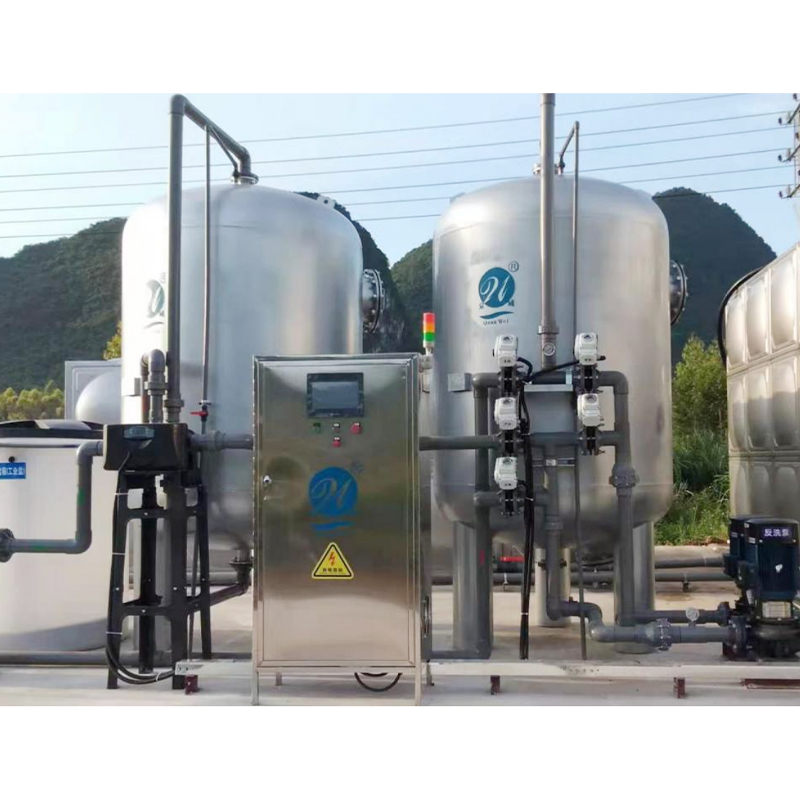
The rationality of the design and operating parameters of sewage treatment equipment has a decisive impact on filter media clogging. If the backwashing intensity is insufficient, the frequency is too low, or the water distribution is uneven, the pollutants trapped in the filter bed cannot be completely removed, and will gradually accumulate and form blockages. For example, single-water backwashing, due to its limited shear force, is difficult to remove sticky impurities on the surface of the filter media; while combined air-water backwashing, through the synergistic effect of air scrubbing and water flow scouring, can significantly improve the backwashing effect. In actual operation, backwashing parameters need to be optimized according to the type of filter media and water quality conditions: for quartz sand filter media, a "air-wash first, water-wash later" mode can be adopted, with the air washing intensity controlled within a certain range, and the water washing intensity and time ensuring sufficient expansion of the filter bed; for fiber bundle filter media, the air washing intensity needs to be reduced to avoid fiber breakage, while the water washing time needs to be extended to remove deep impurities.
Improper management of chemical agent dosing is also an important cause of filter media clogging. For example, excessive addition of polymeric flocculants such as polyacrylamide (PAM) can cause their long-chain molecules to easily entangle on the filter media surface, forming a viscous gel layer. Incompletely dissolved agent particles may directly enter the filter layer, exacerbating the risk of clogging. Therefore, it is necessary to determine the optimal dosage of the agent through beaker tests to avoid overuse. Simultaneously, optimize the agent dissolution and addition methods, such as using a dry powder dosing machine or an online dissolution device to ensure sufficient agent dispersion. For already clogged filter media, chemical cleaning methods can be used for recovery: for organic matter clogging, soaking with sodium hypochlorite or sodium hydroxide solution can be used; for inorganic scale deposits, circulating cleaning with hydrochloric acid or citric acid can be used.
During long-term operation, filter media compaction and excessive biofilm growth are common forms of clogging. Filter media compaction is mostly caused by the failure to promptly remove contaminants trapped in the filter layer, which gradually compact under pressure; excessive biofilm growth is related to excessively high concentrations of organic matter in the influent and incomplete backwashing. For filter media caking, mechanical loosening or high-pressure water jet washing can be used to break up the hardened shell. For biofilm clogging, the biofilm thickness needs to be controlled by adjusting the backwashing intensity and frequency, while simultaneously strengthening influent water quality monitoring to avoid organic load surges.
Seasonal water quality changes and sudden pollution events can also cause filter media clogging. For example, rising water temperatures in summer lead to algal proliferation, and their residues easily clog the filter layer; industrial wastewater leaks may introduce heavy metals or toxic substances, inhibiting microbial activity and damaging the filter media structure. Therefore, a water quality early warning mechanism needs to be established, and process parameters adjusted according to seasonal changes; in the event of sudden pollution, the influent must be immediately stopped and the pollution source investigated, while the contaminated filter media undergoes specialized treatment.
Filter media clogging is a complex problem in the operation of sewage treatment equipment and requires a comprehensive strategy combining source control, process optimization, equipment maintenance, and emergency response. By strengthening pretreatment, selecting suitable filter media, optimizing backwashing processes, standardizing chemical dosing, regularly maintaining equipment, and responding to sudden pollution, the permeability of filter media can be effectively restored, the system treatment efficiency can be improved, and the effluent quality can be guaranteed to meet standards stably.