


How do commercial water dispensers meet the continuous water demand from multiple people during peak hours?
Release Time : 2026-01-21
During school breaks, peak visiting hours at hospitals, busy arrival times at airports, or lunch breaks in company break rooms, water dispensers often face the pressure of a large number of people simultaneously drawing water. Ordinary household models easily fall short in these scenarios—hot water supply becomes intermittent, ice water runs out quickly, and they may even automatically shut down due to overheating. Truly professional commercial water dispensers, however, utilize large-capacity thermal/cold storage systems, efficient heat exchange technology, multiple independent water supply lines, and intelligent load management to ensure a stable, rapid, and continuous supply of appropriately priced drinking water even during peak hours, becoming a reliable "water hub" in public spaces.
The core of this lies in the storage and regeneration capabilities of thermal and cold energy. Unlike household dispensers that rely on low-power instant heating or cooling modules, commercial water dispensers have a built-in large-capacity stainless steel insulated tank (for hot water) and a high-efficiency compressor cooling tank (for ice water). These water storage units act like "energy reservoirs," silently storing energy during off-peak hours: the hot water tank maintains a constant temperature to prevent repeated boiling, while the cold water tank continuously cools, maintaining a low-temperature reserve. When peak water demand arrives, users don't need to wait for heating or cooling; they can directly draw water from the reserves, achieving "instant dispensing." Even with dozens of people drawing water consecutively, the system can rely on its powerful regeneration capabilities to replenish heat or cold in the background, ensuring that the next wave of users still receives sufficient hot or chilled water.
Furthermore, the multi-independent water circuit design ensures that functions do not interfere with each other. High-end commercial models typically physically isolate the ambient temperature, hot water, and chilled water circuits completely, each with its own independent pipes, valves, and outlets. This means that even if the hot water system is operating at full capacity, the chilled water supply will not slow down or heat up; and vice versa. This parallel processing capability greatly improves overall throughput efficiency and avoids queuing caused by bottlenecks in a single water circuit.
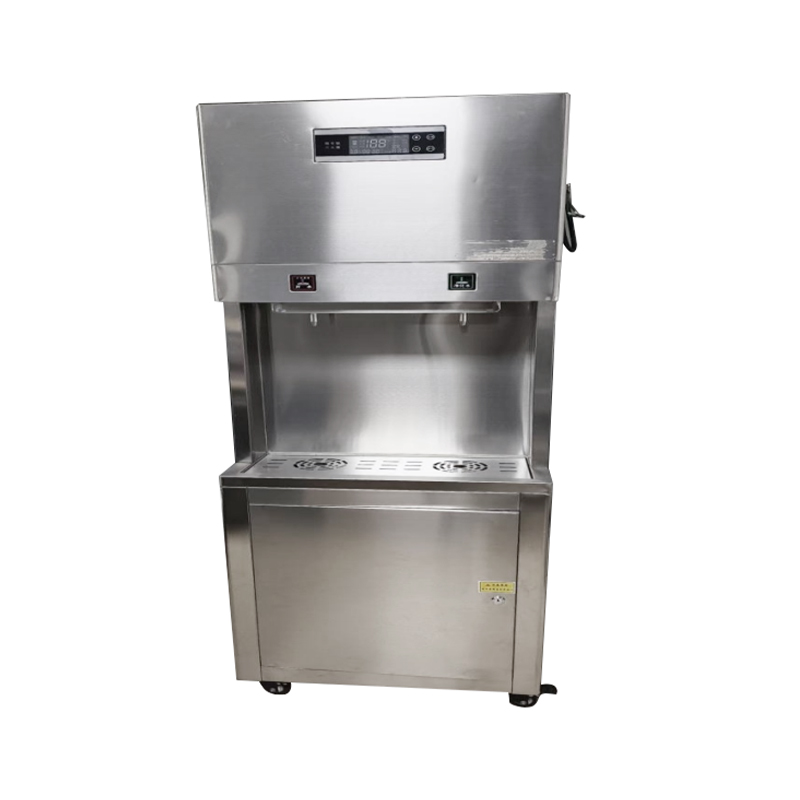
In addition, optimized water outlet structure and flow rate improve the efficiency of single-use water dispensing. The commercial water dispenser's spout is designed with fluid dynamics in mind, ensuring a concentrated and ample water flow, filling a cup in 10 seconds and significantly reducing operation time for each user. Some models also feature dual spouts (one high, one low) to support two people simultaneously; others employ sensor-based/button-based quick-trigger mechanisms to minimize operation delays. These details combined greatly increase the number of people served per unit of time.
Intelligent load balancing and protection mechanisms ensure safe operation even under extreme conditions. When continuous high-intensity use is detected, the system dynamically adjusts heating power or initiates intermittent cooling to prevent compressor overheating. Simultaneously, multiple safety logics, including anti-dry-burning and over-temperature protection, monitor in real time to prevent equipment damage due to water shortage or malfunction. This "efficient and robust" operating strategy keeps the water dispenser in a controllable and reliable state even during peak hours and lunch breaks.
Finally, the tankless direct-connection design (pipeline connection to the municipal water supply) eliminates the risk of interruptions when changing bottled water. No manual handling or waiting for bottle replacements is required; the water supply is continuous and stable, fundamentally eliminating the embarrassing situation of "empty bottles and idle machines," making it particularly suitable for places like airports and train stations where frequent manual intervention is not feasible.
Ultimately, the superiority of the commercial water dispenser lies not in a single flashy feature, but in its engineering-grade approach to building a highly available, high-concurrency drinking water service system. It doesn't pursue extreme compactness, but emphasizes continuous output; it doesn't rely on user patience, but earns trust through efficiency.
Because in the daily operation of public spaces, true reliability means that it remains unhurried when everyone needs it. And that commercial water dispenser, quietly standing at the end of the corridor, is the most solid support for this unhurried approach.
The core of this lies in the storage and regeneration capabilities of thermal and cold energy. Unlike household dispensers that rely on low-power instant heating or cooling modules, commercial water dispensers have a built-in large-capacity stainless steel insulated tank (for hot water) and a high-efficiency compressor cooling tank (for ice water). These water storage units act like "energy reservoirs," silently storing energy during off-peak hours: the hot water tank maintains a constant temperature to prevent repeated boiling, while the cold water tank continuously cools, maintaining a low-temperature reserve. When peak water demand arrives, users don't need to wait for heating or cooling; they can directly draw water from the reserves, achieving "instant dispensing." Even with dozens of people drawing water consecutively, the system can rely on its powerful regeneration capabilities to replenish heat or cold in the background, ensuring that the next wave of users still receives sufficient hot or chilled water.
Furthermore, the multi-independent water circuit design ensures that functions do not interfere with each other. High-end commercial models typically physically isolate the ambient temperature, hot water, and chilled water circuits completely, each with its own independent pipes, valves, and outlets. This means that even if the hot water system is operating at full capacity, the chilled water supply will not slow down or heat up; and vice versa. This parallel processing capability greatly improves overall throughput efficiency and avoids queuing caused by bottlenecks in a single water circuit.
In addition, optimized water outlet structure and flow rate improve the efficiency of single-use water dispensing. The commercial water dispenser's spout is designed with fluid dynamics in mind, ensuring a concentrated and ample water flow, filling a cup in 10 seconds and significantly reducing operation time for each user. Some models also feature dual spouts (one high, one low) to support two people simultaneously; others employ sensor-based/button-based quick-trigger mechanisms to minimize operation delays. These details combined greatly increase the number of people served per unit of time.
Intelligent load balancing and protection mechanisms ensure safe operation even under extreme conditions. When continuous high-intensity use is detected, the system dynamically adjusts heating power or initiates intermittent cooling to prevent compressor overheating. Simultaneously, multiple safety logics, including anti-dry-burning and over-temperature protection, monitor in real time to prevent equipment damage due to water shortage or malfunction. This "efficient and robust" operating strategy keeps the water dispenser in a controllable and reliable state even during peak hours and lunch breaks.
Finally, the tankless direct-connection design (pipeline connection to the municipal water supply) eliminates the risk of interruptions when changing bottled water. No manual handling or waiting for bottle replacements is required; the water supply is continuous and stable, fundamentally eliminating the embarrassing situation of "empty bottles and idle machines," making it particularly suitable for places like airports and train stations where frequent manual intervention is not feasible.
Ultimately, the superiority of the commercial water dispenser lies not in a single flashy feature, but in its engineering-grade approach to building a highly available, high-concurrency drinking water service system. It doesn't pursue extreme compactness, but emphasizes continuous output; it doesn't rely on user patience, but earns trust through efficiency.
Because in the daily operation of public spaces, true reliability means that it remains unhurried when everyone needs it. And that commercial water dispenser, quietly standing at the end of the corridor, is the most solid support for this unhurried approach.